Showing posts with label breastfeeding. Show all posts

Tuesday, September 30, 2008

Fish for Babies? Yes!


Should you give your baby fish to eat? New research implies the answer is yes! In a recent study published in the British Medical Journal, it was found that feeding as little as one portion of fish to babies less than 9 months may cut the risk of eczema by almost 25%. Eczema is a chronic skin condition affecting 10-15% of children and is related to other allergic (atopic) conditions like asthma, hay fever and food allergies. The study was done at the University of Sweden and involved about 5,000 infants.

What type of fish? It didn't matter--however --fatty fish like salmon, add brain building fat (DHA) that babies may not be getting enough of.

What About Allergies?

In the past, the standard recommendation was to delay introducing potentially allergenic foods like dairy, nuts, and fish way past 1 year. However, that advice recently changed. From the summary portion of the latest American Academy of article about this topic:

Effects of Early Nutritional Interventions on the Development of Atopic Disease
in Infants and Children: The Role of Maternal Dietary Restriction,
Breastfeeding, Timing of Introduction of Complementary Foods, and Hydrolyzed
Formulas by Frank R. Greer, MD, Scott H. Sicherer, MD, A. Wesley Burks, MD, and the Committee on Nutrition and Section on Allergy and Immunology.

PEDIATRICS Volume 121, Number 1, January 2008

"Although solid foods should not be introduced before
4 to 6 months of age,there is no current convincing
evidence that delaying their introduction beyond this
period has a significant protective effect on the development
of atopic disease regardless of whether infants
are fed cow milk protein formula or human
milk. This includes delaying the introduction of foods
that are considered to be highly allergic, such as fish,
eggs, and foods containing peanut protein
."


In a nutshell, the article summarizes that EXCLUSIVE BREASTFEEDING for at least 3-4 months does reduce the incidence of some atopic diseases. Research proves once again that breast milk is the ultimate Super Food!

Friday, May 4, 2007

Organic for Babies? YES!!!

Now that organic has gone mainstream, it's more affordable. Now that you have a baby, you're probably thinking more about the environment and how the environment affects your baby's health. That thought process usually leads to the question.....

Should you buy organic for your baby?

YES.

WHY? Pesticides are chemicals meant to kill bugs, mold and other things that hinder a plant's growth and development. Common sense dicates that they can't be good for humans--and science backs it up. Pesticides can be particularly harmful during periods of rapid growth--infancy, puberty, pregnancy--times when important organ systems are developing or growing rapidly. Some pesticides are thought to be endocrine disruptors, which could make a difference to the development of sexual organs.


Baby's First Food: Babies get only one source of nutrition--breastmilk (or formula) for the first 5-6 months. If you figure that all your baby's nutrition is coming from a single source, the quality of that food is of vital importance.

WHEN BREASTFEEDING:
Breastmilk, of course, is the gold standard for infant nutrition. If you're breastfeeding, it's a good idea to consider organic for yourself, at least for some of your foods. (see chapter 3 in Baby Bites for info on how to avoid other environmental chemicals while breastfeeding.)


If you're feeding your baby formula, or a combination of breastmilk and formula, there are several organic options:

Similac Organic
Earth's Best Organic (regular and soy)
Parent's Choice Organic (Available at Walmart)
Ultra Bright Beginnings Organic
Baby's Only Organic (Toddler regular and soy)


Baby Food: Making Your Own

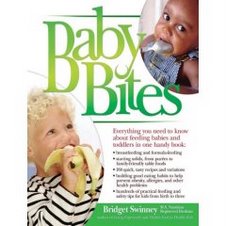
When making your own baby food, (which is really easy especially if you use the simple guidance found in Baby Bites,) you'll want to use organic products, at least for the produce highest in pesticides. Remember that if you buy fresh organic produce, you want it to be as fresh as possible. Another option is to use organic frozen produce, such as Cascadian Farms.


The price of organic can still add up, so you might want to buy only the organic produce that has the most pesticides. The Environmental Working Group has compiled a list of the Best and Worst for pesticide residues. Find it at and more info at: http://www.foodnews.org/


Baby Food: Organic on the Grocery Shelf
At your local grocery, you'll find:

Earth's Best
Gerber Organics

You'll find more at stores like Whole Foods and Wild Oats:

Plum Organics (frozen)
Happy Baby (frozen)
Bobo Baby (in Canada)
Sweetpea (in Canada)

Additionally, there are some regional organic baby food companies:

World Baby Food-Seattle
Sprouts (home delivered Seattle)
Bohemian Baby (fresh organic) -Southern California
Full Tank Foods-L.A.
Homemade Baby-L.A.
My Nami-L.A.

The sales of organic baby food increased a record 21.6% last year--which means more choices, more competition and better prices for consumers. For current news about organic baby food, see http://www.msnbc.msn.com/id/18296482/