Who would have thought that toys made for children could be a prime source of lead based paint? Unfortunatley, it's the sad truth since Mattel and other companies recently recalled toys that were found to have lead based paint in them. To find a list of all recalls in the U.S., go to http://cpsc.gov.
Why is everyone upset about the toy recall (and the recall of many other chemical laced products from China?) Toxins are much more dangerous to children because the effects are more profound during critical stages of development and growth that occur during pregnancy, infancy and early childhood. In general, the younger the child when exposed to a chemical like lead, the more harmful the effects.
Lead is a potent neurotoxin and can profoundly affect the development of the brain and nervous system. When children ingest small amounts of lead over time, as is often the case, the effects are not necessarily dramatic--the long term effects can include:
Reduced IQ
Slowed body growth
Hearing problems
Behavior or attention problems
Failure at school
Kidney damage
Short term symptoms include:
Irritability
Aggressive behavior
Low appetite and energy
Difficulty sleeping
Headaches
Reduced sensations
Loss of previous developmental skills (in young children)
Anemia
Constipation
Abdominal pain and cramping (usually the first sign of a high, toxic dose of lead poison)
Very high levels may cause vomiting, staggering gait, muscle weakness, seizures, or coma
WHAT ARE OTHER SOURCES OF LEAD THAT CHILDREN CAN BE EXPOSED TO?
Lead based paint in houses painted before 1978.
Lead soldered water pipes in older homes that can leach lead into drinking water.
Imported ceramic dishes
Dirt contaminted by lead from car exhaust or industrial waste (more common if you life near a highway, factory of industrial site.
From food or juice stored in crystal or pewter.
For more information about sources of lead, go to:
http://cpsc.gov
http://www.epa.gov/lead
WHY ARE CHILDREN MORE LIKELY TO INGEST LEAD?
The typical behavior of children is makes lead exposure more common. Children put everything in their mouths, including non food items, they are more likely to ingest lead and other environmental chemicals. Also, pound per pound, children eat more and drink more than adults--and they absorb more of everything that is in the food.
HOW MANY CHILDREN HAVE LEAD POISONING?
Unfortunately, exposure to lead is common in children--1 out of 20 preschoolers are thought to have lead poisoning.
WHAT SHOULD YOU DO IF YOU THINK YOUR CHILD HAS EXPOSED TO LEAD?
It's easy to find out for sure. Your health care provider can do a simple blood test; blood levels over 10 micrograms per deciliter is a concern. Chelation therapy can be started to help rid the body of extra lead.
Thursday, August 23, 2007


Saturday, June 30, 2007
Media Literacy--An Important Skill for Kids
I'll never forget how surprised I was when my four year old son recited the slogan of a popular laundry detergent verbatim...especially since we are a family that watches very little TV! It was an "ah-hah" moment-- I realized just how absorbent a kid's mind is when it comes to media.
Now my son is a teenager and he's grown up to be a very media saavy kid--questioning what the real story is behind advertising, research studies, even documentaries.
If you have a toddler, you can add "media literacy" to the list of required learning along with letters, numbers and colors. Why? Kids are bombarded with advertising for fast food and sweets, not to mention subliminal brand advertising that can easily turn your toddler into a little consumer.
The deeper problem with too much media, is it takes time away from other quality activities like playing outside, reading and other imaginative play. If kids are on a constant diet of screen time, it gives their brains little chance to explore their own imagination. And we know that too much time in front of the screen also contributes to childhood obesity.
The American Academy of Pediatrics has guidelines for TV watching that you might want to know:
Kids under 2: No screen time, including educational videos
Kids over 2: 2 hour limit of all screen time
No TV in the bedroom
If you are a mom who wears "lots of hats" (and who doesn't?) you've probably popped a video or two in to keep your toddler busy so you could get something done. That's fine--just try to limit the time. Another idea is to use music as a calming or motivating distraction. A little slow jazz or classical music can "soothe the savage beast"; story time on tape allows your child to expand his mind while building with blocks, for example. If it's a rainy day outside, and you'd like your child to be more active, you can try a video that encourages dancing or other active play like:
Now my son is a teenager and he's grown up to be a very media saavy kid--questioning what the real story is behind advertising, research studies, even documentaries.
If you have a toddler, you can add "media literacy" to the list of required learning along with letters, numbers and colors. Why? Kids are bombarded with advertising for fast food and sweets, not to mention subliminal brand advertising that can easily turn your toddler into a little consumer.
The deeper problem with too much media, is it takes time away from other quality activities like playing outside, reading and other imaginative play. If kids are on a constant diet of screen time, it gives their brains little chance to explore their own imagination. And we know that too much time in front of the screen also contributes to childhood obesity.
The American Academy of Pediatrics has guidelines for TV watching that you might want to know:
Kids under 2: No screen time, including educational videos
Kids over 2: 2 hour limit of all screen time
No TV in the bedroom
If you are a mom who wears "lots of hats" (and who doesn't?) you've probably popped a video or two in to keep your toddler busy so you could get something done. That's fine--just try to limit the time. Another idea is to use music as a calming or motivating distraction. A little slow jazz or classical music can "soothe the savage beast"; story time on tape allows your child to expand his mind while building with blocks, for example. If it's a rainy day outside, and you'd like your child to be more active, you can try a video that encourages dancing or other active play like:
- Sesame Street Elmocize
- Sesame Street Songs-Dance Along
- Little Kicks Workout
- Hip Hop Animal Rock
- Yoga Kids ABC's.
How Can You Teach Media Literacy?
Media literacy is all about teaching kids to recognize, analyze, and evaluate what they see on TV and in other media. How did we get our commercial memorizing kid to be media savvy? We tried to teach him that the purpose of advertising--to get you to buy something--whether you needed it or not. It's amazing how easily kids can learn these concepts. For a little help, there are some great resources on the Internet:
http://pbskids.org/dontbuyit/
http://www.med.umich.edu/1libr/yourchild/media.htm
http://www1.medialiteracy.com/
http://www.amlainfo.org/home/resources
Happy Reading!
Bridget
Wednesday, June 6, 2007
Baby Bites on It's Way to Bookstores!

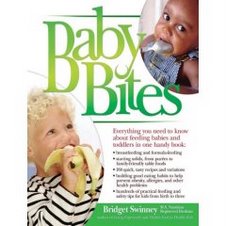
Baby Bites has left the printer and is now on it's way to your local bookstore!
What do you need to know
about Baby Bites?
Price: $15.00
Pages: 370
Easy to Read and Priceless Information!
It has all the nutrition info a new parent needs to know about feeding their new baby and toddler including:
- Breastfeeding
- Formula feeding
- Starting solids
- Making your own baby food
- All about your baby's GI tract
- Prevention and dealing with food allergies
- How to start good eating habits
- Dealing with picky eaters
- Toddler friendly foods
- Dental health
- Preventing childhood obesity
How Can You Find Baby Bites?
1. Call our toll-free number: 800-284-MOMS
and get a personally autographed book!
2. Go to: www.amazon.com
3. Your local bookstore--now available--or available any day now!
What's the Best First Food for Babies?
If you have a new baby about to leap into the world of eating solids, it's most likely you're considering rice cereal as your baby's first food. It's the tried and true first food for a few reasons--
- it's easy to mix to the just the right texture for a new eater
- it's bland
- it's not a highly allergenic food
- it's fortified with iron
But there are a few other foods that would serve just as well as a first food--and sometimes may even be a better choice, especially for exclusively breastfed infants. Exclusively breastfed 7- month old infants do not meet their needs for iron or zinc from breast milk alone.
Other "first foods" to consider? Beef and Lamb. They are high in iron and zinc and pretty well accepted (especially if you follow a recipe from Baby Bites). In an article by Nancy Krebs MD in the February 2007 issue of the Journal of Nutrition, meats are recommended as a complementary first food by breastfed infants. (J. Nutr. 137:511S-517S, February 2007)
When trying any first food for your baby, remember that the food is really not "solid" at all--but more like a thick liquid. And don't be discouraged if your baby spits out his tongue for his first bite of food--it's completely normal. If he continues not enjoying his first meal of solids, don't push it. Just wait a week or two and try again.
Friday, May 4, 2007
Organic for Babies? YES!!!
Now that organic has gone mainstream, it's more affordable. Now that you have a baby, you're probably thinking more about the environment and how the environment affects your baby's health. That thought process usually leads to the question.....
Should you buy organic for your baby?
YES.
WHY? Pesticides are chemicals meant to kill bugs, mold and other things that hinder a plant's growth and development. Common sense dicates that they can't be good for humans--and science backs it up. Pesticides can be particularly harmful during periods of rapid growth--infancy, puberty, pregnancy--times when important organ systems are developing or growing rapidly. Some pesticides are thought to be endocrine disruptors, which could make a difference to the development of sexual organs.
Baby's First Food: Babies get only one source of nutrition--breastmilk (or formula) for the first 5-6 months. If you figure that all your baby's nutrition is coming from a single source, the quality of that food is of vital importance.
WHEN BREASTFEEDING:
Breastmilk, of course, is the gold standard for infant nutrition. If you're breastfeeding, it's a good idea to consider organic for yourself, at least for some of your foods. (see chapter 3 in Baby Bites for info on how to avoid other environmental chemicals while breastfeeding.)

If you're feeding your baby formula, or a combination of breastmilk and formula, there are several organic options:
Similac Organic
Earth's Best Organic (regular and soy)
Parent's Choice Organic (Available at Walmart)
Ultra Bright Beginnings Organic
Baby's Only Organic (Toddler regular and soy)
Baby Food: Making Your Own
When making your own baby food, (which is really easy especially if you use the simple guidance found in Baby Bites,) you'll want to use organic products, at least for the produce highest in pesticides. Remember that if you buy fresh organic produce, you want it to be as fresh as possible. Another option is to use organic frozen produce, such as Cascadian Farms.
The price of organic can still add up, so you might want to buy only the organic produce that has the most pesticides. The Environmental Working Group has compiled a list of the Best and Worst for pesticide residues. Find it at and more info at: http://www.foodnews.org/

Baby Food: Organic on the Grocery Shelf
At your local grocery, you'll find:
Earth's Best
Gerber Organics
You'll find more at stores like Whole Foods and Wild Oats:
Plum Organics (frozen)
Happy Baby (frozen)
Bobo Baby (in Canada)
Sweetpea (in Canada)
Additionally, there are some regional organic baby food companies:
World Baby Food-Seattle
Sprouts (home delivered Seattle)
Bohemian Baby (fresh organic) -Southern California
Full Tank Foods-L.A.
Homemade Baby-L.A.
My Nami-L.A.
The sales of organic baby food increased a record 21.6% last year--which means more choices, more competition and better prices for consumers. For current news about organic baby food, see http://www.msnbc.msn.com/id/18296482/
Should you buy organic for your baby?
YES.
WHY? Pesticides are chemicals meant to kill bugs, mold and other things that hinder a plant's growth and development. Common sense dicates that they can't be good for humans--and science backs it up. Pesticides can be particularly harmful during periods of rapid growth--infancy, puberty, pregnancy--times when important organ systems are developing or growing rapidly. Some pesticides are thought to be endocrine disruptors, which could make a difference to the development of sexual organs.
Baby's First Food: Babies get only one source of nutrition--breastmilk (or formula) for the first 5-6 months. If you figure that all your baby's nutrition is coming from a single source, the quality of that food is of vital importance.

WHEN BREASTFEEDING:
Breastmilk, of course, is the gold standard for infant nutrition. If you're breastfeeding, it's a good idea to consider organic for yourself, at least for some of your foods. (see chapter 3 in Baby Bites for info on how to avoid other environmental chemicals while breastfeeding.)

If you're feeding your baby formula, or a combination of breastmilk and formula, there are several organic options:
Similac Organic
Earth's Best Organic (regular and soy)
Parent's Choice Organic (Available at Walmart)
Ultra Bright Beginnings Organic
Baby's Only Organic (Toddler regular and soy)
Baby Food: Making Your Own
When making your own baby food, (which is really easy especially if you use the simple guidance found in Baby Bites,) you'll want to use organic products, at least for the produce highest in pesticides. Remember that if you buy fresh organic produce, you want it to be as fresh as possible. Another option is to use organic frozen produce, such as Cascadian Farms.
The price of organic can still add up, so you might want to buy only the organic produce that has the most pesticides. The Environmental Working Group has compiled a list of the Best and Worst for pesticide residues. Find it at and more info at: http://www.foodnews.org/

Baby Food: Organic on the Grocery Shelf
At your local grocery, you'll find:
Earth's Best
Gerber Organics
You'll find more at stores like Whole Foods and Wild Oats:
Plum Organics (frozen)
Happy Baby (frozen)
Bobo Baby (in Canada)
Sweetpea (in Canada)
Additionally, there are some regional organic baby food companies:
World Baby Food-Seattle
Sprouts (home delivered Seattle)
Bohemian Baby (fresh organic) -Southern California
Full Tank Foods-L.A.
Homemade Baby-L.A.
My Nami-L.A.
The sales of organic baby food increased a record 21.6% last year--which means more choices, more competition and better prices for consumers. For current news about organic baby food, see http://www.msnbc.msn.com/id/18296482/
Tuesday, May 1, 2007
New Fruit-Veggie Juice for Kids!
OK, so your kid loves juice, but you know you shouldn't give him too much because it's a concentrated source of calories and natural sugars. Good news--there's a new fruit-veggie juice combination from Juicy Juice called Harvest Surprise. Slightly lower in carbs and higher in other nutrients due to the veggie addition, you can feel a bit better about the next glass of juice you pour for your toddler.
Remember the AAP recommends a limit of 4-6 ounces. Kids often want more than that--other ideas to making less, more:
Remember the AAP recommends a limit of 4-6 ounces. Kids often want more than that--other ideas to making less, more:
- water it down by up to half
- add club soda for a fruity soda
Check out the Harvest Surprise Juice at http://www.juicyjuice.com/HarvestSurprise/Public/Default.aspx
Lots of cool info and printable stickers too!
Eating Dinner While Watching TV--------------------More Reasons NOT TO!!
We know that eating as a family fosters much more than just family memories-it helps children build vocabulary, it provides a chance for to parents be good role models for their kids and it even reduces the risk of risky behavior for teens.
BUT--eating together WITH the TV on tends to negate some of the positive effects. In a study conducted by the NY State Department of Health, kids who ate dinner with their families while watching TV ate fewer fruits and veggies than when there was no TV.
Bottom Line: Turn the TV off during meals! The AAP recommends that kids under 2 watch no TV; over 2 should limit to 1 or 2 hours of high quality programming. With an emphasis here on high quality, leave the adult sitcoms, crime investigation and other adult themes for TIVO. When you have little ones, you're just destined to have a television diet more aligned with The Wiggles, Dora and Disney!
BUT--eating together WITH the TV on tends to negate some of the positive effects. In a study conducted by the NY State Department of Health, kids who ate dinner with their families while watching TV ate fewer fruits and veggies than when there was no TV.
Bottom Line: Turn the TV off during meals! The AAP recommends that kids under 2 watch no TV; over 2 should limit to 1 or 2 hours of high quality programming. With an emphasis here on high quality, leave the adult sitcoms, crime investigation and other adult themes for TIVO. When you have little ones, you're just destined to have a television diet more aligned with The Wiggles, Dora and Disney!
Subscribe to:
Posts (Atom)